
What Are Casino Sister Sites?
 Written by Alex Morris
Page edited - 30 September 2026
Casino sister sites are brands connected through an operator or a wider ownership group. Two websites can look completely different and still be run by the same company. Equally, two casinos with matching games and layouts might simply buy software from the same supplier.
The useful question is who runs each website and what that relationship means for your account. Shared ownership alone does not tell you whether bonuses, balances, withdrawal methods or account limits carry across. The distinction matters when you compare offers or need help with an existing account.
Operator, owner and platform: what is the difference?
The operator is the legal business responsible for providing the gambling service. Its name should appear in the site’s terms and licensing information. The parent group owns businesses, which may hold separate licences and use separate account systems. A platform supplier provides technology, such as account management or the games lobby, without necessarily owning the casino brand.
These distinctions explain why two lists of sister sites can disagree. One might list brands under the same gambling licence; another might include every brand owned by a parent company. Both need to say what they are grouping. A list of related companies is not automatically a list of websites where the same login works.
There is another arrangement called a white label. A third party can supply the brand while a licensed operator provides the gambling service. The Gambling Commission’s guidance on white-label partnerships makes clear that responsibility for compliance remains with the licence holder. So two white-label casinos can share an operator without their brand names belonging to the same owner. Our white-label casino guide covers that arrangement in more detail.
Why companies run several casino brands
Different brands give a business different ways to reach customers. A bingo-led website, a sportsbook with a casino section and a slots-focused site can appeal to different audiences while sharing parts of the underlying business. A group can also acquire an established casino and keep its familiar name rather than rename it.
Shared technology and services can reduce duplication, but launching another brand is not cost-free. Marketing, support, payments and regulatory oversight still need resources. Nor does common ownership prove that every brand is an identical copy. The extent of the shared service depends on how the operator has organised its products and partnerships.
How to check whether two casinos are related
- Start with the exact website. Read its footer and current terms. Write down the legal operator and the country or market covered by those terms. A familiar brand name can be used by different companies in different countries.
- Search the official register. For gambling offered to customers in Great Britain, use the Gambling Commission’s public register. Search for the domain or legal business, rather than relying on a logo displayed by the casino.
- Check the record’s details. Confirm the operator’s licence status and relevant gambling activities, then inspect the exact domain entry. An operator record can contain historical information as well as current information.
- Repeat for the second casino. Matching current operators supports a shared-operator relationship. Different operators require a separate ownership check before calling the brands part of the same corporate group.
The register supports searches by business name, trading name, domain and account number. A trading name and a website address are not interchangeable: check the domain you intend to use. The Commission also retains former licensees on the register for three years after their licence ends. Finding a record is therefore only the start of the check.
If the footer and register appear to disagree, do not assume that the more attractive explanation is right. Look for a dated operator-change notice and read the terms for the exact domain. Our casino licence checking guide explains the process, while How We Review describes our approach to evidence.
A real example: one operator, three different websites
Party Casino, Gala Casino and Foxy Bingo illustrate the direct-operator meaning of sister sites. On 30 September 2026, the Gambling Commission’s LC International Limited domain record marked partycasino.com, galacasino.com and foxybingo.com Active under that business. This is better evidence of their British operating relationship than a matching logo, the games they offer or the fact that they sit within a larger corporate family.
That record answers who is responsible for the gambling service on those exact British domains. It does not say the three products have identical logins or bonus rules. It does not tell you which one is more useful if you want slots, live tables or a bingo room. For that, look at the sites themselves and their current terms. The screenshots here show public homepages at their capture dates. They are product examples, not quotes of today’s offers.
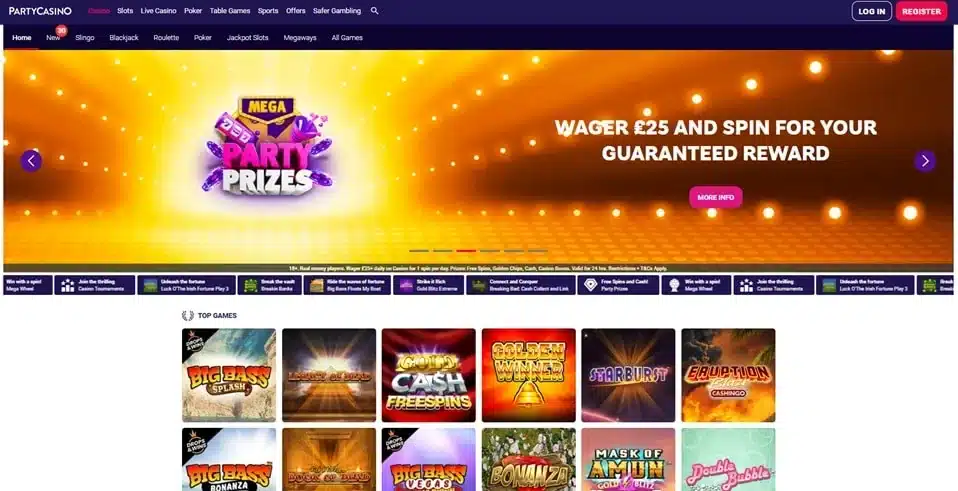
Party Casino: casino categories and featured slots
The July Party Casino view puts Slots, Live Casino, Poker, Table Games and Sports along the top of the screen. A second strip offers routes such as roulette, blackjack and jackpot slots, while a grid of game covers sits below the main panel. If a reader wants a particular table format, those categories are more informative than an operator name alone. The orange reward panel was part of that July view; its amount and availability must not be treated as current.
Gala Casino: a different route through the same operator
Gala Casino’s July page has its own black-and-gold design. The visible top menus separate Casino, Live Casino and Casino Tournaments. The next row offers Slots, New, Exclusive, Roulette, Blackjack, Live, Jackpot Slots, Megaways and Slingo before a shelf of game tiles. Party Casino and Gala Casino may share LC International as their licensed operator, but their pictured menus guide customers differently. The tournament headline in the old image does not establish any tournament running now, or eligibility at Party Casino.

Foxy Bingo: the same operator can run a bingo-led product
The February Foxy Bingo screenshot makes the product difference clearer. Its menu has Bingo and Slingo alongside Slots and Live Casino. Below the purple promotion panel is a line of named bingo-room cards with game formats and play buttons. Those rooms are the centre of the visible page in a way they are not on the Party Casino screenshot. Room availability, ticket prices and any promotion shown in this older view may have changed. Use the Foxy Bingo guide for its own product details, then check the current site before spending money.
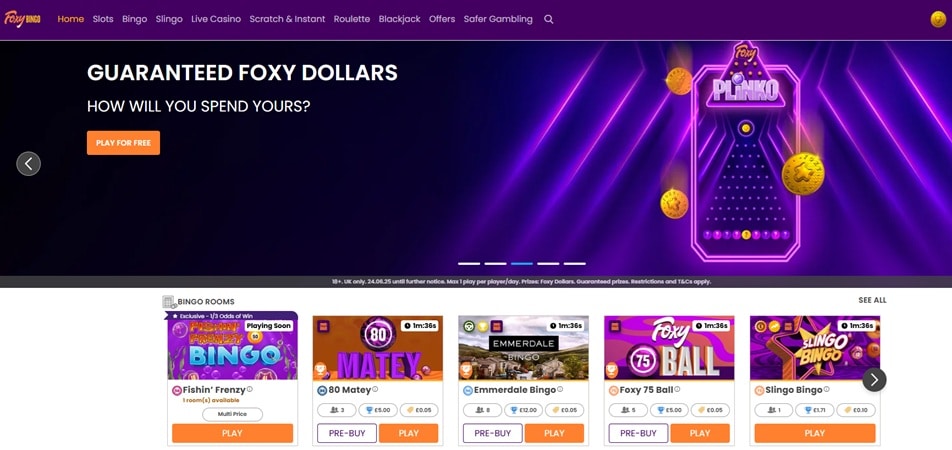
The three pictures do not prove shared customer accounts. The LC International guide maps more brands under the legal operator, while each brand’s terms answer whether an existing customer can use an offer, what information is shared and how a payment is handled. That is why “sister site” should identify a relationship, not promise a particular perk or a second chance at a welcome bonus.
What this example does not prove
A common owner may run different legal operators. Conversely, a white-label brand can sit on a licensee’s record without the consumer brand belonging to that licensee’s parent group. And similar names can point to different businesses: 888 Casino and 888 Bingo are the site’s clear counterexample. Their British domain records sit with separate operators, as the operator directory explains. A matching brand word is no substitute for an exact-domain check.
If you are comparing two casinos, write down both domains and the business named in each set of current terms. Follow the matching official register entries. Then compare the products you would actually use, followed by the account, promotion, payment and safer-gambling terms at each site. If those sources do not align, leave the relationship unconfirmed and look for a dated operator-change notice rather than filling the gap with a guess.
What sister sites may share
Brands under one operator may use common support teams, identity checks, payment services and account policies. They may also offer many of the same games. Those similarities can be useful when comparing websites, but none establishes a universal rule about the experience at every brand.
For example, a common payment provider does not prove that both sites accept the same withdrawal methods. Processing estimates can depend on the method, verification and the terms of the individual service. Likewise, a shared games supplier does not guarantee an identical catalogue, game configuration or promotion.
Check whether an account is shared before assuming a balance will appear elsewhere. A single login is a specific product feature, not something the phrase “sister site” promises. If your account is being transferred following a sale, the migration notice should explain how existing funds, open bets and account access are handled.
What can differ between sister sites?
Compare the details you would actually use: available games, deposit and withdrawal options, published processing times, support hours, account access and promotion terms. Presentation matters too, particularly how easily you can find your balance, spending controls and withdrawal screen on a phone.
A bigger welcome-offer headline is not enough to establish better value. Eligibility, the qualifying deposit, permitted games, wagering conditions and expiry can change the meaning of the offer. Compare those terms together and do not assume that using another brand makes an existing customer eligible again.
Our guides to Jumpman Gaming and Broadway Gaming provide places to explore named brands. Use each brand’s own review for the details that a group overview cannot answer.
Three common misunderstandings
“Related casinos must provide the same quality of service”
A relationship is evidence about the business, not an endorsement. An operator’s regulatory history may be relevant across its brands, but a complaint about one website is not proof that the same event happened elsewhere. Look at the date, company involved and outcome rather than transferring every praise or criticism to the whole group.
“Every sister site gives me another welcome bonus”
There is no universal sister-site bonus entitlement. An offer may exclude customers of named brands, other services run by the operator, or people who have already received a particular promotion. Other offers use different eligibility rules. Read the actual restrictions before opting in; common ownership alone does not settle the question.
“All my account information is shared everywhere”
Neither a shared brand family nor a similar-looking website tells you exactly who receives your information. Read the privacy notice for the named controller, group-company sharing and service providers. Avoid assuming either that each brand is completely separate or that every unrelated gambling business has access to the same account history.
Limits, time-outs and self-exclusion
Self-exclusion is different from an ordinary account closure or a short time-out. The Commission’s remote self-exclusion rules require licensees to close the excluded customer’s accounts and return funds held. Check the operator’s explanation of the scope of your exclusion, especially where a parent group contains several licensed companies.
Deposit limits and time-outs need their own checks. Do not assume that every control automatically uses the same scope as self-exclusion, or that moving brands resets a restriction. If you need confirmation, ask the operator which accounts your chosen control covers.
GAMSTOP Online provides a wider block across online gambling services licensed in Great Britain. It is not limited to the sister sites of one operator. If you are self-excluded, another casino is not a way around that decision. Our GAMSTOP and sister sites guide explains the distinction between an operator’s arrangements and the wider scheme.
Why the operator matters when money or complaints are involved
For a delayed withdrawal or account dispute, identify the company named in the terms and use its complaints process. Keep the website address, relevant dates and correspondence together. Knowing the parent group’s name can provide context, but it does not replace identifying the business responsible for your account.
Unresolved disputes about gambling transactions can be eligible for independent alternative dispute resolution. The Commission’s ADR guidance sets out the eight-week point and the possibility of an earlier referral at deadlock. Follow the operator’s published route to its approved provider.
Also read the terms on protection of customer funds. A recognisable group name does not itself guarantee repayment if a business becomes insolvent. The Commission explains the protection ratings and where the operator must disclose them.
When a casino changes operator
A sale, new licence arrangement or closure can make an old sister-site list misleading. A former connection can still explain a brand’s history, but it should be labelled as historical. Check the effective date of a change and whether it applies to the particular country and website you use.
For instance, a brand might keep the same name after moving to another operator. Its old sister sites would remain part of its history, while current account terms could relate to a different business. A redirect to another casino is also insufficient on its own to establish ownership or confirm what happened to customer accounts.
To find a particular brand, use the A-Z of casino sister sites. To browse by company, use our casino networks directory, which separates operator guides from wider groups and historical coverage.
Sister site basics: FAQs
What makes two casinos sister sites?
The term describes a business relationship, usually a shared operator or parent group. Check which relationship a guide means. Using the same software does not, by itself, establish common ownership.
Can I claim a welcome bonus at every sister site?
Only the individual offer’s eligibility terms can answer that. Some exclude customers of other named brands or the same operator. A different website name does not automatically make you a new customer.
Are sister sites a bad sign?
No. Sharing an operator is neither a quality guarantee nor proof of a problem. It helps identify who is responsible and which terms and regulatory history are relevant to the brand.
How do I find a casino’s current sister sites?
Match its exact domain to the current operator, check other domain entries under that operator, and separate active relationships from former ones. For a wider ownership connection, check the parent company’s current brand information as well.