
How to Check a Casino’s UK Gambling Licence
 Written by Alex Morris
Page edited - 30 September 2026
To check a casino’s licence, match its exact website address and legal operator to the Gambling Commission’s public register. Then check the relevant licence activities and the domain’s status. A licensing logo, a familiar company name or a link to a genuine record is not enough on its own.
You can do this without registering with the casino or making a deposit. Keep the casino’s terms open alongside the register so you can compare the details directly. The check below concerns gambling offered to customers in Great Britain; an overseas licence does not replace the British permission required for that service.
Step 1: Find the operator and licensing statement
Start at the bottom of the casino website and look for the legal company name, its statement about Gambling Commission regulation and a linked account number. Check the terms as well, particularly if the website offers different country editions or lists several companies.
The Commission’s licensed-status display requirements call for the licensee’s name, account number and a link to its register record. The short account number identifies the business; it is not the same as the longer operating-licence reference you may also encounter.
Write down the domain shown in your browser, not just the brand name on the page. If you were redirected, note where you ended up. A review of one address does not necessarily establish the status of another address using similar branding.
Step 2: Search the official business register
Open the Gambling Commission’s business register. You can search by domain, company, trading name or account number. Confirm that the destination is on the Commission’s own website before relying on a result reached from a casino footer.
Choose the business record that matches the company named in the terms. Do not substitute a similarly named business, the brand’s parent group or a company’s retail premises record. Online casino services need the appropriate remote permissions; an entry for a physical gambling venue does not answer that question.
If the number leads to a real company but the website is missing, the check is incomplete. The business may be genuine while the site’s use of its details is inaccurate. Compare the record with the exact domain and current terms before drawing a conclusion.
Step 3: Match the domain and read its status
Open the domain-name section of the business record and look for the actual address. Trading names can help identify a brand, but they are not a substitute for its domain entry. Also check whether there are old and new addresses, rather than treating all similarly named entries as one live website.
The Commission explains the domain labels as follows:
- Active: the operator has reported that it uses the domain to offer gambling.
- Inactive: the domain is not currently in use under that entry. It may have stopped trading or not yet started.
- White Label: a licensed operator runs the domain in partnership with another organisation. This is not, by itself, a warning that the site is unlicensed.
The domain label and the licence status are different checks. An active business can have inactive domains, and a white-label domain still needs to be considered alongside its operator’s permissions. The register also notes that domain and trading-name information is supplied by gambling businesses. If the evidence conflicts, keep the result unresolved rather than guessing which detail is wrong.
Step 4: Check the licence activities and current status
Read the licensed activities, their dates and any current restrictions. Confirm that they cover the service you are checking. A company offering several products may have more than one entry, so a single status found elsewhere in its record may not describe the online casino.
An active licence is current. Surrendered means the business has given it up; revoked means it has been withdrawn, including for non-payment where specified. Suspended indicates a suspension pending investigation. A lapsed or expired entry is not an active permission, while pending is not confirmation that a new licence is in force.
Read the associated notice if a status has changed. Do not continue on the assumption that a familiar brand can use an old licence indefinitely. Equally, a non-active entry does not establish that every service run by a similarly named company has closed worldwide.
Follow one casino address through the register
Party Casino offers a useful example because its public British domain has a direct match in the register. Start with the address in the browser, partycasino.com, and the legal company named in the site’s current licensing statement. Search the Gambling Commission business register for that domain or for LC International Limited. A search result is only the start: open the company’s own record and check the details below before treating the match as settled.
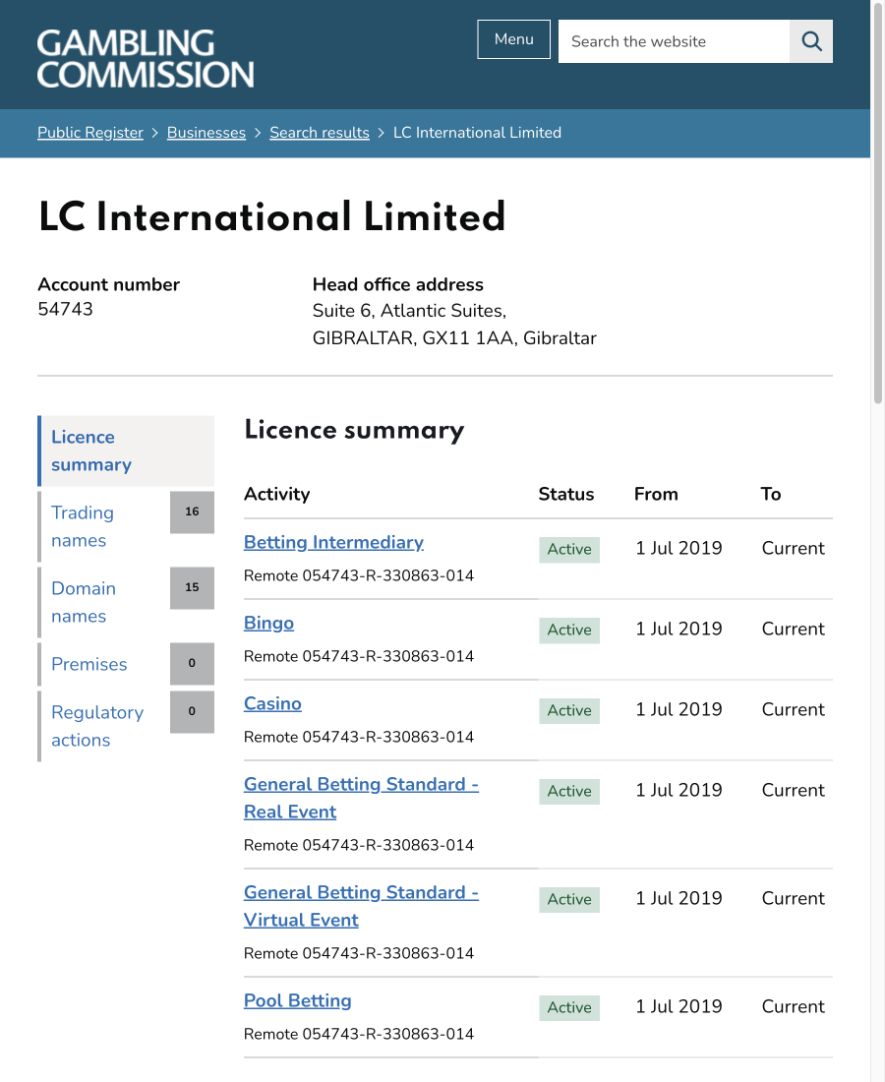
On 30 September 2026, the LC International Limited licence summary displayed a Casino activity marked Remote and Active. The same record also listed other activities, including Bingo, which helps explain why a legal operator can serve more than one kind of gambling brand. The casino activity and its status are the relevant lines when checking an online casino. The regulator’s account reference identifies LC International’s record; it is not a shortcut that lets an unrelated website borrow that company’s permission.
Next open the record’s domain-name section. It displayed partycasino.com as Active on 30 September 2026. That is the exact-address check. The same list includes other brands, but their presence does not mean their account rules, bonus eligibility or customer balances are identical. If you are checking a different address, search for that address on its own row. Do not assume that a lookalike spelling, a redirect or a branded landing page inherits the status of partycasino.com.
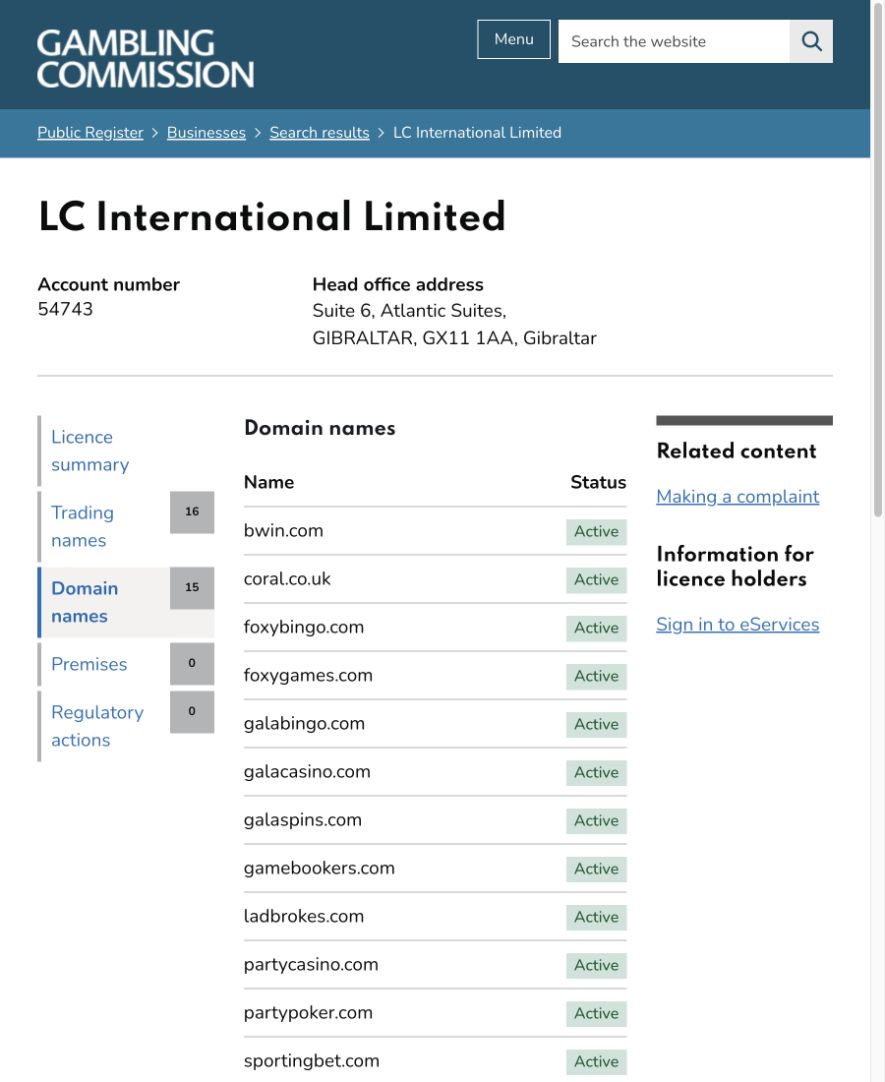
This is a dated example of how to read the register, not a permanent approval stamp. It supports the narrower finding that LC International had an active remote casino permission and partycasino.com was reported as an active domain at the time of this check. It does not establish whether a promotion is available today, whether a withdrawal will be fast or what happened to a particular player’s funds. Those questions need the brand’s current terms and, for an account issue, its complaints procedure.
If the name or address fails to match
Go back to the actual URL in the browser and compare it with the domain row, character for character. Read the full legal-entity wording in the site’s terms, because a parent-company name in a press release may differ from the licensed business named on the site. If a redirect took you elsewhere, check the destination as well. A correctly licensed brand at one address does not by itself authenticate the destination of every redirect or advert.
If the register lists the business but omits the domain, the result is unresolved. The site may have moved or the register data may need updating; neither possibility is proof that the current address is authorised. Look for a dated operator-change or migration notice and contact the business through its published support channel if necessary. Do not enter payment details while the discrepancy remains unexplained. The Commission says businesses supply its trading-name and domain information, so a register row should be read together with the current website rather than in isolation.
Read domain labels as separate facts
The BV Gaming Limited domain list makes this distinction visible on one screen. At our 30 September check, betvictor.com appeared in the Active section, puntit.co.uk in the Inactive section and heartbingo.co.uk in the White Label section. The legal operator record connects these rows, but their labels do different jobs. Inactive does not mean “another currently available sister casino”. White Label describes a business arrangement, not a warning that the brand lacks a licensed operator.
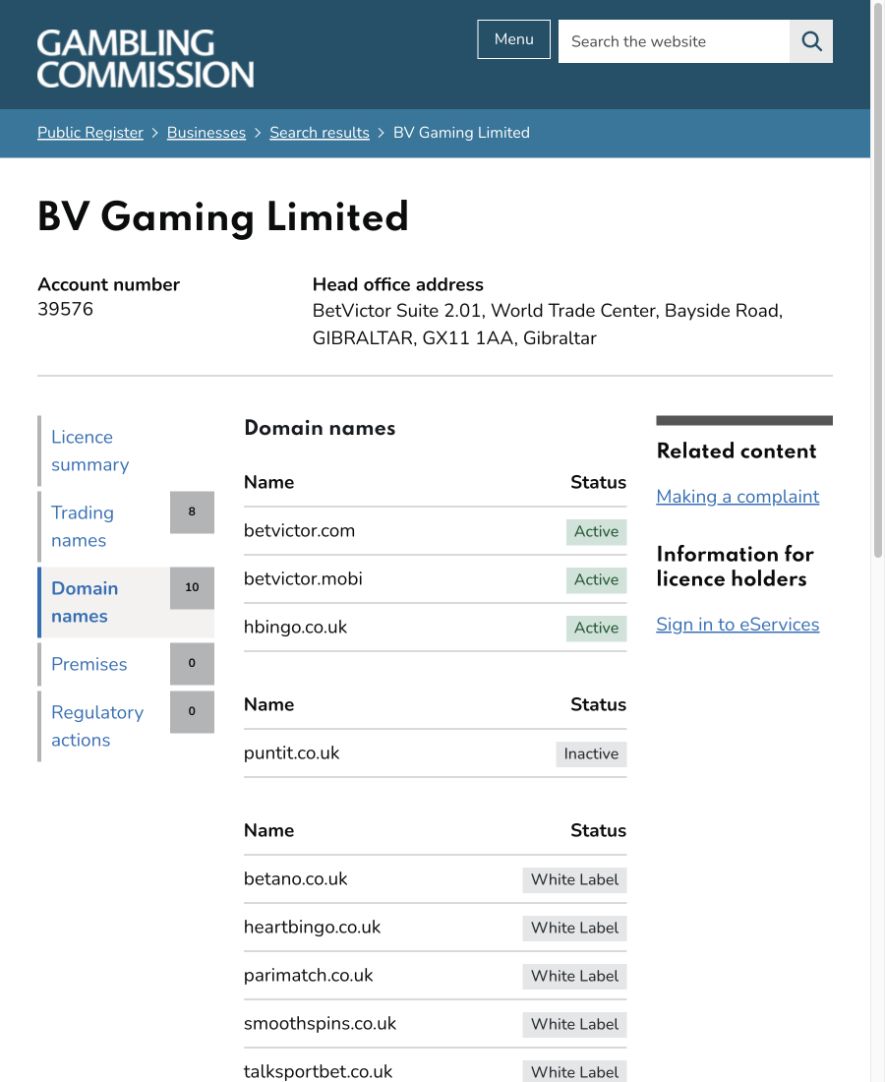
For a white-label brand such as Heart Bingo, use the exact domain and then read the site’s own terms to understand the customer-facing business. For an inactive address such as puntit.co.uk, do not recommend it as somewhere to sign up merely because it remains in the historical domain list. For an active address such as BetVictor, finish by checking the relevant remote activities and current status on the operator’s licence summary. Each question needs its own line of evidence.
Keep a short record of the check
Write down the exact domain, the legal operator named in the current terms, the date of your register check, the remote activity and status, and the domain label. If you are comparing two sites, make a separate note for each. That is enough to revisit the evidence later without mistaking an old screenshot for a live status. It also makes a discrepancy clear: you can point to the particular address or legal name that does not match, rather than saying only that the casino “looks licensed”.
Step 5: Read the regulatory history in context
Open any linked regulatory action and check the legal entity, event date, failures identified and outcome. A warning, a financial penalty, a settlement and a suspension are different outcomes. Describe the finding that was actually made rather than assuming that every investigation resulted in the same sanction.
Dates matter here. A notice can describe conduct from an earlier period and then be updated after a later decision. Read those updates before relying on the original headline. Ownership may also have changed since the events, which belongs in the context rather than being ignored.
A past finding is relevant information, but it is not a guarantee about what will happen to an individual account. Nor does an empty recent-action section certify that an operator has never had a problem. Our review methodology explains how licensing evidence fits alongside the rest of a casino review.
When to repeat the check
Check again when you see an operator-change notice, new legal terms or a redirect to another website. It also makes sense to revisit the record after a long break or when an old review is your only source. A familiar design and an unchanged brand name do not establish that the legal operator is unchanged.
Keep the date alongside any note you make. The Commission retains former licensees on its register for three years after the licence ends. Historical entries are useful evidence, but finding one does not prove that the permission remains active today.
If the footer is missing or the details disagree
Search the exact domain directly and read the site’s current terms for a company name. If the results still do not match, do not deposit while the position is unresolved. Missing information is a reason to pause, not a reason to accept a vague claim that a website is “fully licensed”.
An overseas address is not inherently a problem: a business based abroad can hold British permissions. What matters is the appropriate Gambling Commission licence for the service offered to consumers in Great Britain. The Commission’s remote-sector guidance explains that requirement.
If you already have money in an account, keep the relevant terms and correspondence and read any official closure or suspension notice. Do not assume that a changed licence status means you should abandon a withdrawal request. For example, the Commission’s In Touch Games notice stated that its September 2023 suspension did not prevent account access and withdrawals. That is a historical example, not a promise about another operator’s circumstances.
What a successful check does not tell you
Licensing establishes the regulatory position of the service. It does not guarantee fast withdrawals, good customer support, favourable offers or repayment in insolvency. Read the individual terms and the operator’s customer-funds protection disclosure separately.
It also does not mean the Commission will settle an individual payment dispute. Start with the business’s complaints procedure. The Commission’s customer enquiries guidance explains that it cannot access your account to investigate a withdrawal for you.
For related brands, read our explanation of casino sister sites and browse the operator directory. Distinguish a shared legal operator from a wider parent group, and current domains from former brands.
Licence checking FAQs
Where do I find a casino’s licence number?
Look in its footer and licensing statement for the legal operator and linked account number. Compare the current terms as well. If those details are absent, search the exact domain on the Commission’s business register.
What does surrendered or lapsed mean?
That licence is no longer active. Check the relevant activities and any official notice, including instructions for existing customers. The status does not erase the need to pursue an outstanding account query through the appropriate route.
Is a Curaçao licence enough for customers in Great Britain?
No. An overseas licence is not a substitute for the Gambling Commission permission required to provide the online gambling service to consumers in Great Britain.
What if the footer and register do not match?
Leave the result unresolved and do not deposit. Check the exact domain, legal company and any dated migration notice. A matching brand name alone does not resolve the discrepancy.
This site is for readers aged 18 and over. Licensing does not remove the risks of gambling. GambleAware lists support options, and our GAMSTOP guide explains online self-exclusion.